Chest discomfort, breathlessness, palpitations, fainting, swelling, and a sudden drop in stamina can signal a heart problem, even when the symptoms seem mild or resemble indigestion. You will learn which patterns require an emergency call, which justify a prompt appointment, what risk factors change the threshold for evaluation, and how to prepare for a useful consultation.
Key takeaways
- Call emergency services for chest pressure that lasts, returns, worsens, or spreads.
- Book a cardiology appointment for recurring palpitations, breathlessness, dizziness, or swelling.
- Track blood pressure, pulse, symptoms, triggers, duration, and current medicines.
- Bring test reports, medication details, family history, and a symptom timeline.
Call for emergency help when symptoms suggest an immediate heart problem
Treat new chest pressure, squeezing, fullness, or pain at rest as a chest pain emergency. Call emergency services if it lasts more than a few minutes, returns, worsens, or spreads to your arm, jaw, back, neck, or shoulder. Do not wait for a routine cardiology appointment.
- Call immediately for severe breathlessness, sudden cold sweating, blue lips, fainting, or nausea or unusual weakness without obvious chest pain.
- Call immediately for stroke signs: facial drooping, arm weakness, speech difficulty, sudden confusion, or new vision loss.
- If blood pressure is above 180/120 mmHg, repeat it after one minute. Call emergency services when the reading accompanies chest pain, breathlessness, confusion, vision change, weakness, or another new neurological symptom.
- Do not drive yourself when severe symptoms are present. Ask someone to stay with you and follow the emergency operator’s instructions.
| Symptom pattern | Action | Why it matters |
|---|---|---|
| Chest pressure or pain at rest, or discomfort that recurs or worsens | Emergency call | It can signal an acute heart problem. |
| Severe breathlessness, blue lips, sweating, or fainting and heart symptoms | Emergency call | Oxygen shortage or a dangerous rhythm needs rapid assessment. |
| Brief discomfort only with exertion that stops with rest | Cardiology appointment | It can still represent stable angina and needs evaluation. |
Symptoms that warrant a scheduled cardiology appointment
Exertional chest pressure, squeezing, fullness, or discomfort lasting a few minutes and improving with rest can fit stable angina symptoms. Arrange cardiology assessment rather than dismissing it as indigestion or poor fitness.
- New or worsening breathlessness during ordinary activity
- Reduced exercise tolerance, unexplained fatigue, or dizziness
- Intermittent palpitations, especially with repeated episodes
- Ankle or leg swelling, which can signal heart failure
- A new or changing heart murmur
- An unexplained faint, particularly during exercise, while lying down, or after palpitations
A brief, isolated flutter without fainting, chest pain, severe breathlessness, or marked dizziness is generally less concerning. Palpitations with any of those features require urgent evaluation.
| Pattern | What it may indicate | Action |
|---|---|---|
| Exertional discomfort relieved by rest | Stable angina | Schedule cardiology review |
| Breathlessness lying flat or waking gasping | Fluid congestion from heart failure | Seek prompt medical attention |
| Rapidly increasing ankle or abdominal swelling or sudden weight gain | Worsening fluid retention | Seek prompt medical attention |
| Chest discomfort or breathlessness at rest, lasting more than a few minutes, or becoming more frequent or severe | Possible acute heart problem | Call emergency help |
Do not automatically blame these changes on age or lung disease. New symptoms deserve assessment, particularly when your usual walking, climbing, or working pace has become harder.
Why heart symptoms are easy to miss in some people
Atypical heart attack symptoms can include breathlessness, unusual fatigue, nausea, sweating, or pain in the back, jaw, neck, or arms without obvious chest pressure. Pay particular attention to heart symptoms in women, heart disease in older adults, and diabetes and heart symptoms; these groups can have reduced or absent chest pain.
Indigestion-like discomfort after exertion is not automatically harmless. New or worsening fatigue, or breathlessness on a walk that was previously easy, deserves assessment even if your resting vital signs seem normal.
| Fainting pattern | Why it matters | Action |
|---|---|---|
| During exercise | May indicate an abnormal rhythm or restricted blood flow | Prompt cardiovascular assessment |
| While lying down | Less typical of a simple faint | Prompt cardiovascular assessment |
| After palpitations | The rhythm may have reduced blood flow to the brain | Urgent evaluation |
| After prolonged standing, heat, pain, or dehydration | Fits a common reflex or volume-related faint | Still discuss it if recurrent or unexplained |
Clinicians also assess anemia, lung disease, medication effects, and conditioning when reduced stamina is the main complaint. A brief isolated flutter without fainting, chest pain, severe breathlessness, or marked dizziness is generally less concerning; those accompanying features need urgent evaluation.
Risk factors and readings that lower the threshold for evaluation
Cardiovascular risk factors justify assessment before symptoms appear. They include high blood pressure, diabetes, high cholesterol, smoking, obesity, kidney disease, a family history of premature heart disease, and previous pregnancy-related hypertension or diabetes.
| Finding | What it means | What to do |
|---|---|---|
| High blood pressure | Clinic readings of 140/90 mmHg or higher, or home readings of 135/85 mmHg or higher, when sustained | Confirm with repeat measurements and arrange risk assessment; do not diagnose from one anxious or painful reading |
| LDL cholesterol | LDL 190 mg/dL (4.9 mmol/L) or higher | Seek prompt evaluation for possible familial hypercholesterolemia and treatment planning |
| Family history | A first-degree relative with coronary disease before 55 in men or 65 in women, or unexplained sudden death | Arrange earlier cardiovascular assessment |
These findings are different from symptoms: they raise future risk without proving that heart disease is present. A clinician can also assess overall risk when several factors occur together, even if each individual result seems modest.
An irregular pulse or smartwatch alert is a screening signal, not a diagnosis of atrial fibrillation; obtain ECG confirmation. A reading above 180/120 mmHg with chest pain, breathlessness, confusion, vision change, weakness, or another new neurological symptom requires emergency care, not a routine appointment.
What to record and bring to the appointment
Bring a short symptom diary to your cardiology appointment; it helps the cardiologist judge urgency and choose tests. Record when each symptom began, its duration and frequency, the activity or trigger, whether rest relieved it, and associated sweating, nausea, dizziness, swelling, or palpitations.
Note the activity level that now causes symptoms, such as walking one block or climbing stairs.
| Information | What to record or bring | Why it helps |
|---|---|---|
| Blood pressure log | Pulse and blood-pressure readings with dates, times, and whether you were resting | Shows a pattern; do not rely on one reading |
| Medical records for cardiologist | Medication and supplement names with doses, previous ECGs, blood-test reports including cholesterol, imaging reports, and discharge summaries | Prevents repeated tests and clarifies treatment risks |
| Family history | Early coronary disease or unexplained sudden death, including the relative’s age | Identifies inherited risk |
| Witness account | Ask anyone who saw a faint or rhythm episode to describe what happened, including duration and recovery | Adds details you may not remember |
What happens at the first cardiology visit
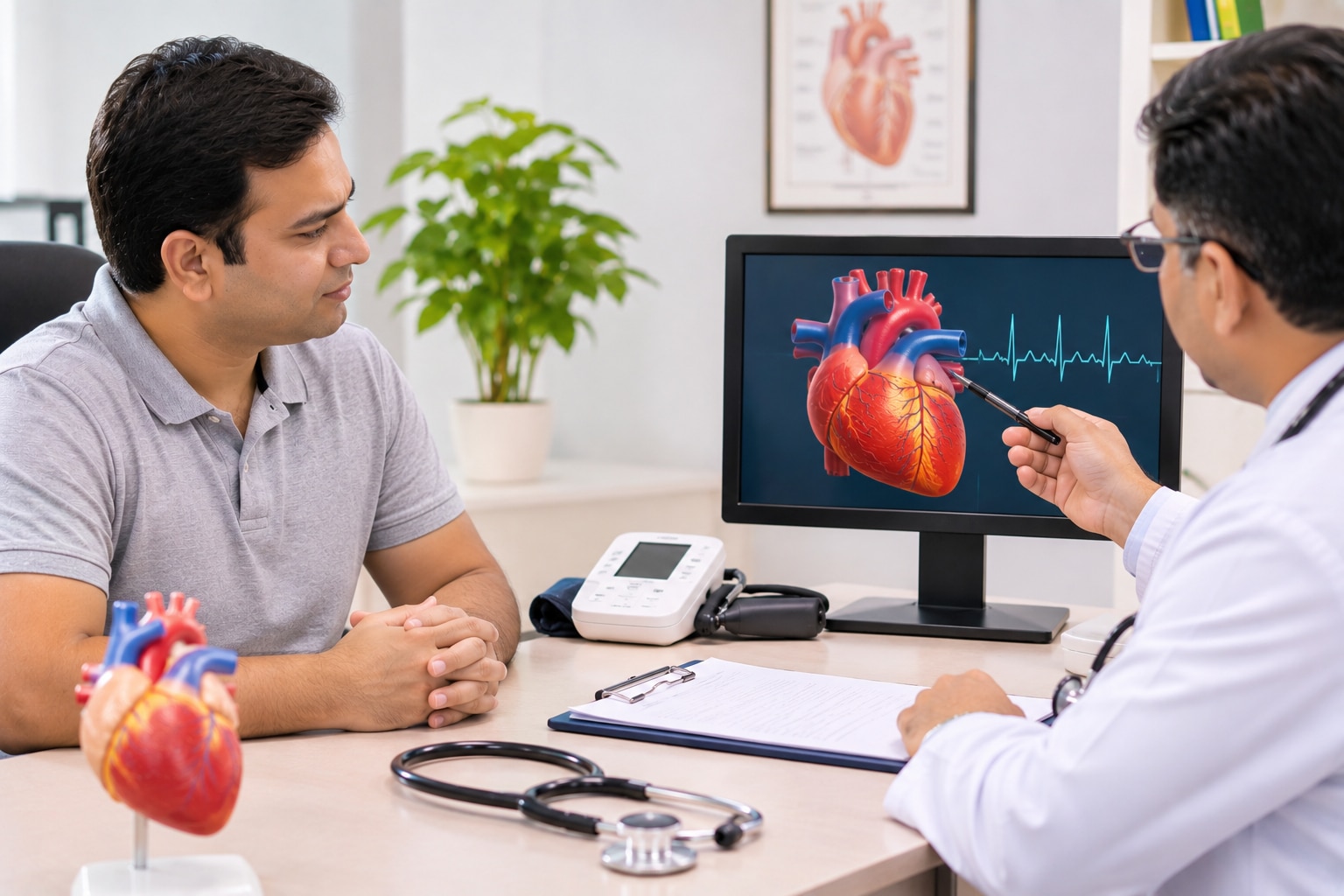
At a first cardiology consultation, the cardiologist reviews your symptoms, their timing, triggers, duration, medical and family history, medicines, and cardiovascular risk factors. The visit then includes a physical examination and vital-sign measurements. Blood pressure may be checked in both arms when your history or examination makes that useful, and an ECG may be performed.
There is no universal test package. Findings and symptom patterns determine the next step:
| Test | What it checks | When it may follow |
|---|---|---|
| Echocardiography | Heart structure and pumping | Murmur, breathlessness, swelling, or abnormal examination |
| Ambulatory rhythm monitoring | Intermittent rhythm problems | Palpitations, dizziness, or fainting not captured during the visit |
| Stress testing | Heart response to exertion | Predictable exertional discomfort or reduced exercise tolerance |
| Blood tests | Conditions affecting heart risk or symptoms | Cholesterol, anaemia, thyroid disease, or other suspected causes |
Bring your symptom record, medicine and supplement list, previous ECGs, blood-test results, imaging reports, and discharge summaries. In PCMC-Pune, contact Hinjawadi SuperSpeciality Hospital 08048033666 to ask about arranging an outpatient consultation and which records to bring. Emergency symptoms require an emergency call, not an appointment.
Related service
Cardiology ₹1200 All cardiologists in the branch of medicine study the disorders of the heart, but the study of adult and child heart disorders each requires... |
Frequently asked questions
When should chest symptoms be treated as a heart emergency?
Call emergency services for new chest pressure, squeezing, fullness, or pain at rest that lasts more than a few minutes, returns, worsens, or spreads to the arm, jaw, back, neck, or shoulder.
Which symptoms warrant a scheduled cardiology appointment?
Arrange an appointment for recurring palpitations, breathlessness, dizziness, fainting, unusual fatigue, ankle swelling, or symptoms that appear with exertion.
Why can heart symptoms be easy to miss?
Symptoms can be mild, atypical, or confused with indigestion, anxiety, fatigue, or muscle pain. Women, older adults, and people with diabetes may not have classic chest pain.
What should you record before seeing a cardiologist?
Record when symptoms began, how long they lasted, what triggered them, associated symptoms, blood pressure and pulse readings, medicines, and relevant family history.
What happens during a first cardiology visit?
The cardiologist reviews your symptoms, medical and family history, medicines, and readings, then performs an examination and decides whether tests such as an ECG, echocardiogram, blood tests, or stress testing are needed.